
HMRC can require a company to account for VAT from an effective registration date that falls weeks before its VAT number arrives. That gap is exactly why so many new UK businesses ask how to invoice while waiting for a VAT registration number without issuing invalid documents.
In this guide, we discuss when VAT begins and how to invoice before your number arrives. We explain how to calculate VAT from exclusive and inclusive prices. We also cover reissuing invoices and preventing duplicate payments.
When Does the VAT Obligation Actually Begin Before the Number Arrives?
VAT accounting begins on the effective registration date HMRC sets, not on the date the VAT number is issued.
HMRC's VAT Notice 700/1 distinguishes the effective registration date from notification of the number. A voluntary registrant accounts for VAT from the date HMRC confirms. This will normally be the date requested and may be an agreed earlier date.
That distinction creates a practical gap. Supplies with tax points on or after the effective date fall within the registration, even if the number has not arrived when you invoice. Supplies with earlier tax points generally do not.
The date must be confirmed, not assumed. Businesses should check the date HMRC actually sets and the treatment of each supply. Do not assume that every invoice dated after registration is automatically taxable. Tax points, including advance payments, determine which supplies need review, and continuous supplies need particular care. The effective date drives every later step. Our team considers it when helping clients with VAT registration services in the UK.
How Should You Invoice Customers While the Registration Is Pending?
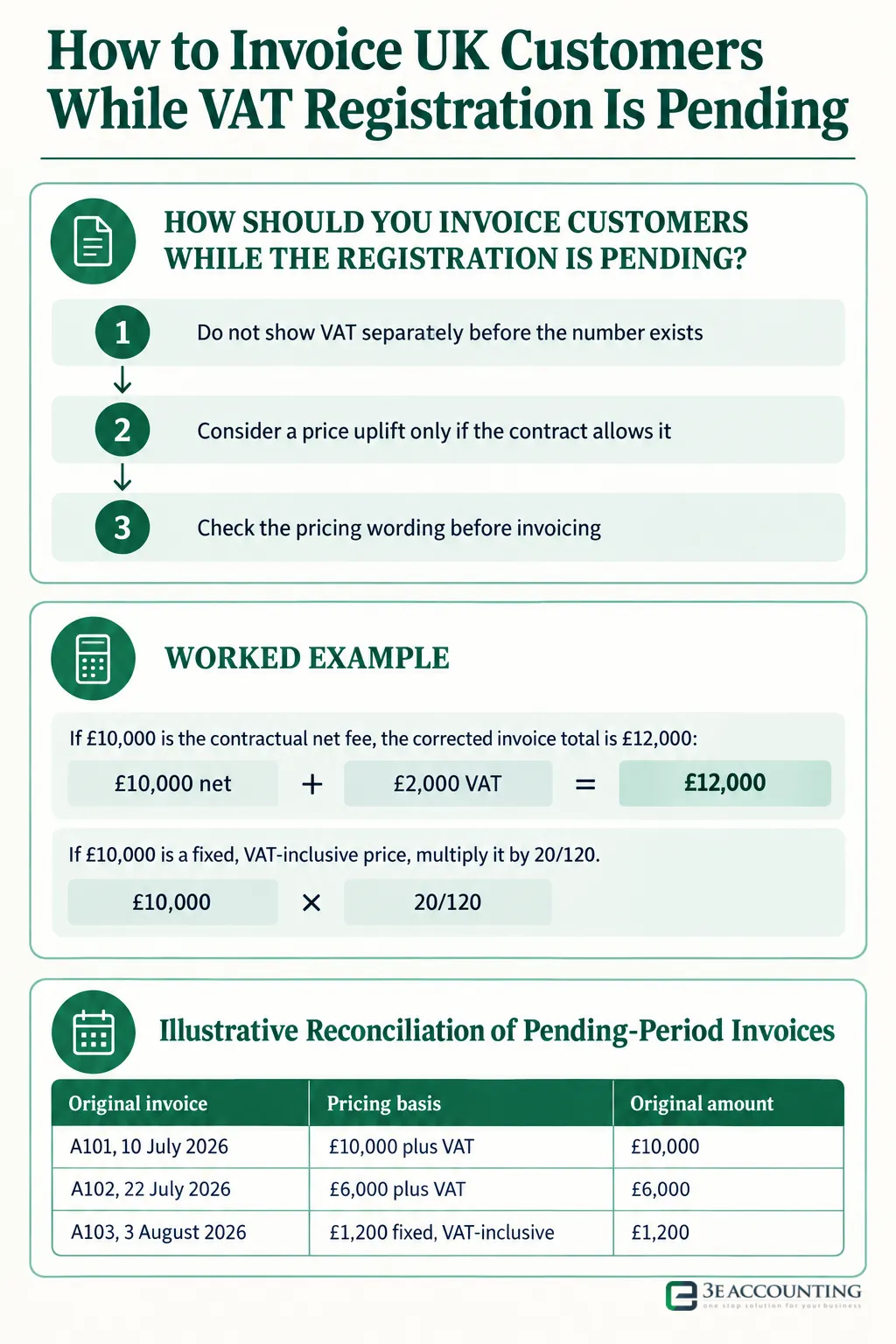
Issue commercial invoices that do not show VAT as a separate charge, and only increase the total price where the contract genuinely permits it.
Many founders register a company with Companies House long before VAT crosses their minds, so the pending period often catches them mid-trade. HMRC's guidance on charging VAT while your registration is pending sets two basic rules. First, do not show VAT separately on invoices issued before the number exists. Second, a business may increase its prices to account for the VAT it will owe.
Read the second rule carefully. The guidance illustrates a price increase, but it does not create a contractual right to raise an agreed price. Whether any uplift is recoverable from the customer depends on the agreement, the accepted quotation and any consumer protections that apply.
1. Do not show VAT separately before the number exists
A document that charges VAT without a VAT number is not a valid VAT invoice. Issue it as a commercial invoice and state plainly that no VAT is separately charged while registration is pending. Do not label the supply zero-rated; the correct treatment simply has not been evidenced on that document yet.
2. Consider a price uplift only if the contract allows it
An increase to the invoice total can build in the VAT that will become due once registration takes effect. An uplift depends on the agreed terms: an applicable price-adjustment clause can also permit an increase to a VAT-inclusive price. A later invoice footer cannot manufacture a right to recover extra money after the fact.
3. Check the pricing wording before invoicing
Check the signed contract, accepted quotation, purchase order and incorporated terms, including any tax-adjustment clause. Conflicting 'fixed', 'all-inclusive' or VAT-inclusive wording changes the outcome entirely. This is our team's professional judgement, not settled law. Have an appropriately qualified reviewer confirm the contractual position for significant contracts.
VAT Calculations at the 20% Standard Rate (Illustrative Figures)
| Pricing basis | Invoice total | Net revenue | VAT element | Suggested cash reserve |
|---|---|---|---|---|
| Fee of £10,000 exclusive of VAT | £12,000 | £10,000 | £2,000 | £2,000 |
| Fixed price of £10,000 including VAT | £10,000 | £8,333.33 | £1,666.67 | £1,666.67 |
How Do You Calculate the VAT Element from Exclusive and Inclusive Prices?
Multiply a VAT-exclusive fee by 20% to find the VAT; divide a VAT-inclusive price by six to strip the VAT out.
Assume a hypothetical, ordinary UK service supplied at the 20% standard rate, with an enforceable fee of £10,000. If £10,000 is the contractual net fee, the corrected invoice total is £12,000: £10,000 net plus £2,000 VAT. If the customer has already paid £10,000, only the £2,000 VAT balance remains collectible.
If £10,000 is a fixed, VAT-inclusive price, multiply it by 20/120. The VAT is £1,666.67, leaving £8,333.33 of net revenue. A common mistake is charging 20% of the gross figure, which overstates the VAT by £333.33. HMRC identifies one sixth as the VAT fraction at the standard rate.
For cash planning, we suggest reserving the full output VAT. This applies to supplies whose tax points fall on or after the effective date. That reserve is before any allowable input VAT credit, so it is not necessarily the final return payment. Standard VAT accounting can require payment before the customer pays. Eligible businesses on cash accounting account for VAT differently. These are planning suggestions from our team's work with clients, not an HMRC reserve requirement, and the illustrative figures remain hypothetical.
What Must You Do Once the VAT Registration Number Arrives?
Confirm the effective date and issue any necessary VAT invoices within HMRC's 30-day guidance. Allocate existing payments so nobody is charged twice.
Once the number arrives, HMRC's pending-registration guidance says to send any necessary VAT invoices within 30 days. This is guidance on the documents that are needed, not a blanket duty to reissue every customer with a full VAT invoice. It is also separate from the ordinary rule, which generally requires a VAT invoice to be issued within 30 days of the tax point.
A replacement must carry the particulars required on a full VAT invoice. That includes a unique sequential number, the actual issue date, the correctly determined tax point, the supplier's VAT number and the VAT amounts. The list is not exhaustive, and simplified invoice rules may apply to smaller supplies.
Getting this transition right also helps businesses avoid common VAT errors in the United Kingdom, from missed tax points to duplicated receivables. To keep control, we suggest tracking each original against its contract basis, tax point, receipt, replacement, remaining balance and VAT return period. That tracker is a proposal from our team's workflow, not an HMRC-prescribed format, although HMRC does require records sufficient to support your VAT accounting.
1. Confirm the effective date and classify each supply
Check the effective date against HMRC's notification, then determine the tax point of every supply invoiced during the gap. Advance payments and continuous supplies need particular care. Never split a job that spans the registration date automatically, and remember that a later VAT invoice can itself affect the tax point under the applicable rules.
2. Replace the commercial invoices, not just renumber them
Each replacement should cross-reference the original, show payments already allocated and state the precise balance due. Preserve the original documents and keep a complete link between each original and its replacement in your records.
3. Reconcile paid and unpaid originals separately
For an original already paid, reverse or cancel the original entry as your software requires, post the replacement, and transfer the existing receipt to it. Only a contractually authorised balance remains collectible. For an unpaid original, remove the open receivable and replace it with the corrected gross figure.
One caution from our team's practice: a cancellation against an invoice that charged no VAT must not create a fictitious VAT credit. A valid VAT credit note must reflect a genuine mistake, overcharge or agreed reduction in value, among other conditions. Returning an accidental overpayment is a refund, not a VAT credit note.
Illustrative Reconciliation of Pending-Period Invoices (Fictional Composite)
| Original invoice | Pricing basis | Original amount | Already paid | Replacement VAT invoice | Balance to collect |
|---|---|---|---|---|---|
| A101, 10 July 2026 | £10,000 plus VAT | £10,000 | £10,000 | £12,000 (£2,000 VAT) | £2,000 |
| A102, 22 July 2026 | £6,000 plus VAT | £6,000 | Nil | £7,200 (£1,200 VAT) | £7,200 |
| A103, 3 August 2026 | £1,200 fixed, VAT-inclusive | £1,200 | £1,200 | £1,200 (£200 VAT) | Nil |
How Does the Full Sequence Play Out in Practice?
A deliberately fictional composite shows how three invoices issued during the gap are classified, replaced and reconciled once the number arrives.
Consider a fictional consultancy, not a real client. It applies on 6 July 2026 for voluntary registration from 1 July 2026. HMRC confirms that requested effective date when the number arrives on 17 August. All supplies are ordinary UK standard-rated services completed on their invoice dates, with no earlier payments.
While waiting, the company issues three commercial invoices without showing VAT separately. The £10,000 invoice is VAT-exclusive and paid in full. The £6,000 invoice is VAT-exclusive and unpaid. The third is a fixed £1,200 VAT-inclusive total and is also paid. On 18 August, the effective date is checked against HMRC's notification. The contracts and tax points are also checked. In this example, each original is replaced with a properly numbered VAT invoice that cross-references it.
The teaching point is that receiving the number does not start the VAT liability. The effective date and tax points govern, and a fully paid invoice can still require correction. Every figure and date in this example is illustrative only.
How Should You Communicate With Customers During the Transition?
Explain that VAT is not shown separately while the number is pending, though VAT may still be due. Present any replacement as a correction, not a second sale.
A short note can state that registration is pending and the commercial invoice is not a VAT invoice. Explain that a replacement VAT invoice will follow where required for supplies within the registration period. Where a price uplift applies, explain the contractual adjustment without showing VAT as though a number already exists.
With a replacement, explain which invoice it replaces and give the total including VAT. Show payments already credited and the exact balance due. Include a cross-reference and payment reconciliation rather than emailing a bare invoice. Our team considers apparent duplicates and unexpected surcharges common sources of confusion.
These messages are draft wording from our practice, conditional on the actual contract and confirmed VAT treatment. If wording is prompting queries or disputes, contact us before the next invoice run so the terms can be checked first.
Suggested Tracker Fields for Invoices Issued While VAT Registration Is Pending
| Tracker field | What it records |
|---|---|
| Original reference and issue date | Identifies the pre-registration document |
| Contract and pricing basis | Records whether the fee is VAT-exclusive or fixed inclusive |
| Determined tax point | Drives whether the supply falls inside the registration |
| Effective registration date | The date HMRC confirmed, used for classification |
| Receipt date and amount | Supports allocation and prevents duplicate demands |
| Replacement reference and issue date | Links the original to its correction |
| Remaining balance | States the precise amount still collectible |
| VAT return period | Confirms where the output VAT is reported |
| Reviewer sign-off | Adds a control before replacements are issued |
Which VAT Return Period Covers Supplies Invoiced During the Gap?
VAT is generally accounted for in the period of the actual tax point, subject to scheme rules.
HMRC's VAT return guidance generally requires VAT to be accounted for in the period of the tax point, subject to schemes and other rules. A later replacement does not automatically move the liability. Under the ordinary 14-day rule, a VAT invoice issued within 14 days of the basic tax point may set a later actual tax point. Advance payments and exceptions can affect the result. Check the actual tax point, the applicable scheme and the return period before filing.
If an earlier return was submitted incorrectly, apply HMRC's error-correction guidance. Do not assume the replacement date fixes it. Historic corrections must feed the proper period, not simply land in the issue period of the replacement invoice.
From the customer's side, a VAT-registered buyer normally needs appropriate VAT evidence to reclaim input tax, and recovery depends on its own entitlement. A commercial invoice from the pending period is not normally valid evidence. Cash accounting changes when eligible VAT is accounted for and cannot be applied retrospectively. The Flat Rate Scheme uses its own turnover method. Its invoices still show the normal VAT rate, not the scheme percentage. Check eligibility, exclusions and start dates for either scheme.
Conclusion
Start by respecting the effective date HMRC sets. Keep pending-registration documents accurate and reconcile each replacement against its original. Do these well and the transition is routine; skip them and duplicate payments, missing output VAT and disputed balances tend to follow.
3E Accounting United Kingdom is a Corporate Services Provider supporting startups, SMEs and multinational companies operating in the UK. Our team helps clients confirm effective dates, review contract pricing wording, prepare compliant replacement invoices and trackers, and plan the cash reserve needed for the first VAT return.
Where the position is unclear, professional support keeps the sequence compliant and your records accurate. Reach out to our UK team to review your pending-registration invoices before the number arrives.
Need Help With Pending VAT Registration Invoices?
Our UK team can review your contracts, prepare compliant replacement invoices and plan your first VAT return.
Frequently Asked Questions
You should not show VAT separately on invoices issued before the number exists, though VAT may still be due. You may increase your prices to account for the VAT you will owe, but only where the contract genuinely supports the uplift, and you still account for VAT from the effective registration date HMRC sets.
HMRC guidance says to send any necessary VAT invoices within 30 days of receiving the number. Which invoices need replacing depends on the effective date and each supply's tax point, not simply on when the invoices were sent.
Allocate the existing payment to the replacement VAT invoice and request only the contractually authorised balance. On VAT-exclusive terms that is usually the VAT top-up; on a fixed inclusive price it is normally nothing. A clear covering message prevents the customer paying twice.
Generally, account for VAT in the period of the actual tax point, subject to scheme rules. A VAT invoice issued within 14 days of the basic tax point may affect that date. If an earlier return was filed incorrectly, apply HMRC's error-correction guidance rather than assuming the replacement date fixes it.
A VAT-registered customer normally needs a valid VAT invoice as evidence, and recovery also depends on its own entitlement. A commercial invoice issued during the pending period is not normally valid evidence, which is why the replacement matters.

Abigail Yu
Director
Abigail Yu oversees executive leadership at 3E Accounting Group, leading operations, IT solutions, public relations, and digital marketing to drive business success. She holds an honors degree in Communication and New Media from the National University of Singapore and is highly skilled in crisis management, financial communication, and corporate communications.