
Who received the supply usually matters more than who paid the supplier. When an overseas parent pays a UK subsidiary's start-up costs, VAT recovery, ledger entries and corporation tax deductions each turn on that single distinction.
In this guide, we discuss UK subsidiary startup costs accounting when an overseas parent pays. We cover pre-incorporation VAT relief, intercompany reverse charges and FRS 102 journal entries. We also examine formation and pre-trading costs for corporation tax, using a clearly hypothetical launch.
Why Do UK Subsidiary Startup Costs Turn on Who Received the Supply?
The key question is who received the supply and what evidence supports it, not whose bank account settled the invoice.
When we open a parent-paid launch file, the first question is never who paid the supplier. HM Revenue and Customs (HMRC) ties input tax recovery to the taxable supply the claimant received, supported by appropriate evidence — a payment record alone proves very little.
That said, the distinction drawn below — between paying, receiving and later supplying — is our proposed analysis rather than a confirmed position. Each transaction needs its own contractual and supply arrangements checked before any figure is certain.
The pattern that matters most is simple. Paying a supplier's invoice, receiving a supply and subsequently supplying something are three separate events. An overseas parent that settles a UK supplier's bill has financed a transaction; it has not automatically received the supply. Equally, a genuine purchase made by the parent — market-entry research, for example — does not become the subsidiary's purchase just because the parent later raises an invoice.
The same questions run through every kind of launch. The payer-versus-recipient analysis applies when starting a tutoring business in the United Kingdom. It also applies when starting a mobile beautician business in the United Kingdom. Any corporate market entry faces the same analysis, starting before the first invoice. Our guide covers how to set up your business in the UK the smart way.
Can the Subsidiary Reclaim VAT on Pre-Incorporation Expenses?
Yes — within fixed time limits, and for pre-incorporation purchases only where HMRC's special promoter conditions are satisfied.
Our team looks first at who received the supply and whether the evidence supports a claim. The parent's payment alone does not establish the subsidiary's entitlement. Pre-incorporation purchases have additional conditions.
A clearly hypothetical launch shows the working in general terms only. A future director pays some pre-incorporation invoices as promoter. An overseas parent pays other supplier invoices directly. The parent later raises a recharge for its own support work. Before incorporation, the promoter may meet legal and equipment costs; after incorporation, the subsidiary may receive accountancy and rent invoices that the parent settles. The parent may also have bought market-entry advice for itself before the company existed.
On those assumptions, the promoter-paid pre-incorporation costs may qualify under HMRC's special conditions. The accountancy invoice may qualify as a pre-registration service. The post-registration rent may be normal input tax. The parent's own earlier research purchase is not the subsidiary's purchase, so the subsidiary would not claim VAT on it. Any later genuine support service is analysed separately. These events are illustrative assumptions rather than an actual engagement, and a VAT specialist should verify the promoter conditions, timing and evidence before any claim.
One further point from HMRC's guidance: a launch that later fails does not automatically bar recovery, provided a genuine intention to make taxable supplies can be evidenced. Corporation tax relief is different: relief under section 61 generally requires trading to have commenced, although other rules may provide relief before then.
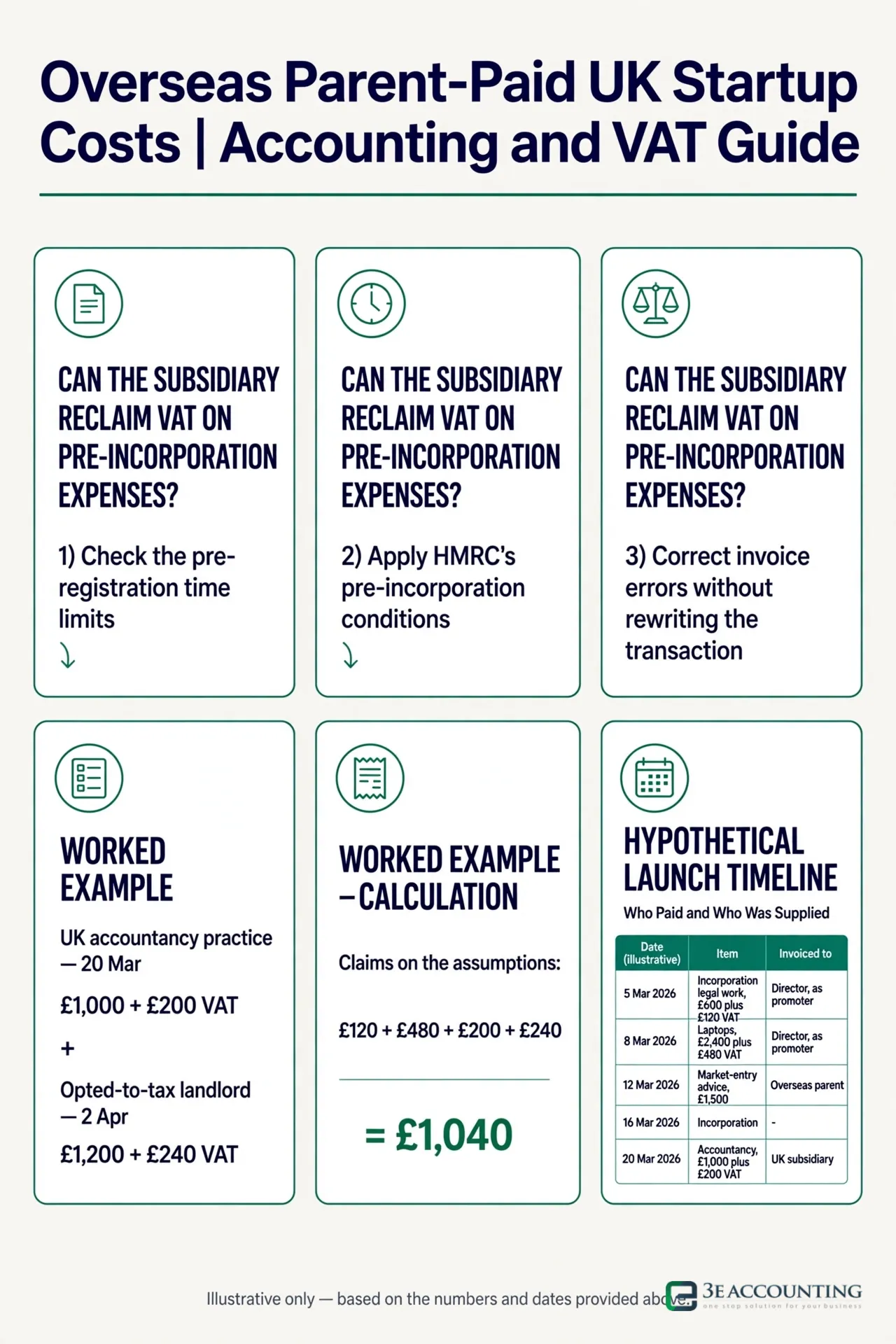
1. Check the pre-registration time limits
HMRC's pre-registration rules give two separate windows. Normally, qualifying goods must have been acquired in the four years before the effective date of VAT registration, and qualifying services received in the six months before it; different periods can apply to capital items under the Capital Goods Scheme. Goods generally must still be held, or incorporated into goods still held, and every claim needs business purpose, taxable use and proper evidence.
2. Apply HMRC's pre-incorporation conditions
Where a person buys goods for a company that does not yet exist, special conditions apply. HMRC's VAT Notice 700 and regulation 111 address pre-incorporation VAT relief. A company may claim qualifying VAT on purchases made for it by a future member, officer or employee. The purchaser must not have been a taxable person when the supply was made. Business purpose and use, reimbursement or a qualifying undertaking, time limits and evidence also need checking. Eligibility must be established — never assumed.
3. Correct invoice errors without rewriting the transaction
An invoice addressed to the wrong entity is not automatically fatal if it is a genuine error and the underlying supply was to the company. Seek a supplier correction supported by the contract and delivery evidence; HMRC may accept alternative evidence at its discretion. That is our proposed interpretation rather than a settled rule, and discretion is never automatic. What a correction cannot do is change the substance: editing a name on paper does not turn the parent's own purchase into the subsidiary's purchase.
Hypothetical Launch Timeline: Who Paid and Who Was Supplied
| Date (illustrative) | Item | Invoiced to | Paid by | Indicative VAT position |
|---|---|---|---|---|
| 5 Mar 2026 | Incorporation legal work, £600 plus £120 VAT | Director, as promoter | Director personally | Potentially recoverable under pre-incorporation conditions |
| 8 Mar 2026 | Laptops, £2,400 plus £480 VAT | Director, as promoter | Director personally | Potentially recoverable if assets held for taxable use |
| 12 Mar 2026 | Market-entry advice, £1,500 | Overseas parent | Parent directly | Parent's own purchase; no UK claim for the subsidiary |
| 16 Mar 2026 | Incorporation | – | – | Company formed at Companies House |
| 20 Mar 2026 | Accountancy, £1,000 plus £200 VAT | UK subsidiary | Overseas parent | Pre-registration service claim if conditions met |
| 1 Apr 2026 | VAT registration effective | – | – | Pre-registration claim reported on first return |
| 2 Apr 2026 | Rent, opted-to-tax landlord, £1,200 plus £240 VAT | UK subsidiary | Overseas parent | Post-registration input tax under normal rules |
| 15 Apr 2026 | Parent support service, £1,500 | UK subsidiary | Recharged by parent | Reverse charge if a general-rule B2B service |
| 1 Jun 2026 | Trading starts | – | – | Section 61 pre-trading window closes |
VAT Recovery Windows Before UK VAT Registration
| Cost type | Time limit | Key conditions | Source of the rule |
|---|---|---|---|
| Qualifying goods | 4 years before the effective registration date | Goods still held, or incorporated into goods still held; taxable business use; evidence | HMRC VAT guidance |
| Qualifying services | 6 months before the effective registration date | Received for a taxable business purpose; valid VAT invoice; evidence | HMRC VAT guidance |
| Pre-incorporation purchases by a promoter | Special conditions apply | Purchaser later becomes member, officer or employee; reimbursement or qualifying undertaking; business use; time limits | VAT Notice 700 and regulation 111 |
When Does the Reverse Charge Apply to Parent-Supplied Services?
A genuine, general-rule business-to-business service supplied by the overseas parent to the UK subsidiary normally requires the subsidiary to self-account through the reverse charge.
A taxable general-rule B2B service can be subject to UK VAT even when the parent charges no UK VAT. The place of supply is where the customer belongs. Where the reverse charge applies, the subsidiary reports output VAT on its return. It claims input tax only to the extent the normal rules allow. The actual service, both parties' establishments, the applicable exceptions and the tax point all need checking first.
A UK VAT number on the parent's paperwork does not settle the question. HMRC distinguishes registration from establishment and looks at which establishment is involved in the supply; ownership of a subsidiary does not by itself change the analysis. Where a UK fixed establishment of the parent is genuinely involved, the position needs rechecking.
Recharges deserve separate care. Passing a cost on at cost does not automatically make it a VAT disbursement. HMRC sets strict agency and disbursement conditions. A recharge may instead relate to the parent's own supply, subject to the normal VAT rules. Distinguish a true disbursement from a recharge on the documents, not on the amount.
In a parent-supplied support service of the kind described, the subsidiary would self-account for reverse-charge output VAT. On the stated assumptions, it would reclaim input VAT to the extent deductible under normal rules. That proposed treatment still needs confirming against the actual contract and service description.
How Should the Books Record Parent-Paid Start-Up Costs?
Record the obligations and assets the company has genuinely accepted:
- label every proposed entry for review
- Record a parent balance according to its substance: a genuine capital contribution may be recognised in equity without a share allotment, but share capital requires an actual allotment.
Under Financial Reporting Standard 102 (FRS 102), paragraph 18.8C, establishment and other specified start-up costs are expenses, not internally generated intangible assets. This includes the legal and secretarial costs of forming a company. First confirm the framework applies and that each cost is genuinely the company's; qualifying prepayments are dealt with separately by the same standard.
Pre-incorporation contracts need legal care. Under Companies Act 2006 section 51, a person who purports to contract on behalf of a company not yet formed can remain personally liable, subject to any contrary agreement. A company does not automatically inherit a contract signed before it existed. Take advice on a fresh agreement, a novation or another transfer before assuming the obligations are the company's.
The proposed journal approach is an unconfirmed draft, not approved firm postings, and still needs review by a qualified reviewer. It assumes FRS 102, sterling as functional currency, valid transfers of ownership, recoverable VAT and full taxable business use. Before registration, VAT can sit in a pre-registration control account pending the claim; the director's reimbursement then clears the creditor through the bank.
Funding follows documents. A parent balance is recorded as an intercompany payable, assuming the obligation is confirmed — never as an unexplained credit to share capital. A later debt-for-shares swap needs an actual allotment, and the nominal share capital and any premium follow that allotment paperwork. This proposed treatment is part of the same unconfirmed draft and should not be posted as settled guidance.
Proposed Journal Entries for a Parent-Paid Launch
| Transaction (assumed) | Debit | Credit | Note |
|---|---|---|---|
| Promoter's incorporation work | Formation/legal expense £600; recoverable VAT £120 | Director creditor £720 | Promoter conditions to be confirmed |
| Promoter's laptops | Computer equipment £2,400; recoverable VAT £480 | Director creditor £2,880 | Four-year goods rule; assets held for the business |
| Director reimbursement, 10 Apr | Director creditor £3,600 | Bank £3,600 | Full reimbursement supports the claim |
| Accountancy, 20 Mar | Accountancy £1,000; input VAT £200 | Parent payable £1,200 | Parent paid; supply made to the subsidiary |
| Rent, 2 Apr | Rent or prepayment £1,200; input VAT £240 | Parent payable £1,440 | Post-registration input tax |
| Parent support service, 15 Apr | Support expense £1,500; input VAT £300 | Parent payable £1,500; reverse-charge output VAT £300 | Reverse charge to be confirmed; entries are proposed, not approved |
What Are the Corporation Tax Consequences of Start-Up Expenditure?
Sort every launch invoice by its nature and legal incidence:
- formation fees are generally capital
- qualifying pre-trading revenue expenditure can be deducted
- equipment goes through capital allowances
The label start-up has no corporation tax meaning. Every launch invoice is assessed by what it bought and who incurred it, and the treatment below reflects the hypothetical launch rather than a real one.
1. Treat formation and capital-structure fees as capital
Section 53 of the Corporation Tax Act 2009 stops capital expenditure from reducing trading profits, so formation legal fees of the kind in the hypothetical are added back. Share-issue and capital-structure legal work joins the same review. Companies House publishes its current incorporation fees for online and paper form IN01 filings. Those fees are a real cost of forming the company, not automatically a deduction from trading profits.
2. Claim qualifying pre-trading revenue expenditure under section 61
Section 61 CTA 2009 covers qualifying revenue expenditure the company incurs within seven years before trading starts. It can be treated as incurred on the first trading day. It must have been deductible then and not otherwise relieved. The expenditure must be the company's own; a parent's or promoter's original spend does not qualify automatically, and the trade must actually commence. On the assumptions given, accountancy work of an operational nature is reviewed as pre-trading expenditure. The rent and the support charge are assessed for period and purpose.
3. Claim capital allowances on equipment
Equipment goes through capital allowances. HMRC lists computers among the assets that can qualify, and laptops may attract the annual investment allowance (AIA) where its conditions are met. Confirm the company's qualifying expenditure, ownership, timing and any shared-allowance restrictions — capitalising the laptops in the accounts does not by itself establish the claim.
4. Flag the costs that need review
The items we review first include:
- mixed legal invoices that blend formation and operational work;
- expenditure on acquiring a business or an enduring right;
- software development costs;
- recruitment linked to acquiring a business rather than employing staff;
- recoverable deposits;
- parental management fees with no identifiable benefit to the company.
Connected-party pricing and the company's actual liability matter too. If the parent paid for its own investment appraisal, relabelling it as market research does not manufacture a subsidiary deduction. And if recruitment produces the subsidiary's first employees, first time hires in the UK and registering for PAYE starts its own compliance timetable.
One Cost, Three Treatments: Accounts, VAT and Corporation Tax
| Cost (illustrative) | Accounting under FRS 102 | VAT | Corporation tax |
|---|---|---|---|
| Formation legal fees, £600 | Expense in profit or loss | Potentially recoverable under pre-incorporation conditions | Added back as capital under section 53 CTA 2009 |
| Laptops, £2,400 | Capitalised as equipment | Potentially recoverable | Capital allowances, including AIA if conditions met |
| Pre-trading accountancy, £1,000 | Expense or prepayment by period | Recoverable pre-registration service | Deductible under section 61 CTA 2009 once trading starts |
| Parent's research, £1,500 | Not the company's cost | No UK input tax claim | No deduction for the subsidiary |
What Documents Should the Parent Provide Before Costs Enter the Books?
Ask for one invoice register first, then the evidence behind it — the checklist below is a proposed working list, not an established firm procedure.
This proposed checklist shows what overseas groups could assemble before recording launch costs. It should be confirmed by the responsible service lead before it is treated as standing guidance, and HMRC's evidence requirements govern what ultimately supports any VAT claim.
1. Build the invoice register
One row per invoice, showing:
- supplier and invoice date;
- service period and contractual customer;
- currency, net amount and VAT charged;
- who actually paid, and on what date;
- the proposed accounting and VAT treatment.
2. Prove the promoter's reimbursement
Behind the register sit the original invoices and the engagement letters, orders or delivery evidence that support them. For promoter-paid costs, the proposed checklist includes the director's signed expense claim and proof of acting for the proposed company. It also includes evidence of full reimbursement or a qualifying undertaking. The incorporation documents, officer details, the VAT registration effective date and evidence of intended taxable activity complete the claim file. Equipment needs ownership, location and use records.
3. Reconcile the parent balance
Parent balances are reconciled, not assumed. A suggested schedule, agreed by both entities, identifies each supplier payment, advance, recharge and settlement. It avoids an unexplained opening balance labelled as owed to the parent.
Conclusion
Parent-paid start-up costs sit exactly where VAT, accounting and corporation tax diverge. One invoice can be expensed under FRS 102 and qualify for pre-registration VAT recovery. It can still be added back as capital for corporation tax. Each treatment depends on its own evidence and conditions.
The discipline that protects the group is documentary. Know who received each supply, prove the promoter's reimbursement, reconcile the intercompany balance, and label every unconfirmed treatment for review rather than posting it as settled.
3E Accounting United Kingdom works with overseas parents and their UK subsidiaries from incorporation through the first VAT return and corporation tax computation. If your group is planning a UK launch — or untangling launch costs already paid — our corporate services team can review the invoices, the claims and the entries. They can do so before the figures reach HMRC.
Need Help With a UK Launch?
Share your parent-paid launch invoices with our corporate services team for a structured review before your first VAT return.
Frequently Asked Questions
Yes, if the underlying supply was genuinely made to the subsidiary and the evidence supports it. Payment by the parent does not by itself block recovery, but pre-incorporation purchases must satisfy HMRC's special promoter conditions.
Qualifying goods acquired in the four years before registration and qualifying services received in the six months before it can be claimed on the first VAT return, subject to HMRC's conditions on retention, business use and evidence.
Usually yes, if the parent supplies a genuine general-rule B2B service to the UK company. The subsidiary self-accounts for the VAT and reclaims it to the extent normally allowed; a UK VAT number on the parent's invoice does not change the analysis.
Generally no. Formation costs are treated as capital, and section 53 of the Corporation Tax Act 2009 excludes capital expenditure from trading profits. Qualifying pre-trading revenue expenditure may be deducted under section 61 once trading starts.
Not automatically. A payable or loan may be appropriate if the company owes the parent; a genuine capital contribution may instead be recognised in equity without a share allotment. Share capital requires an actual allotment. Confirm the funding terms and applicable accounting before recording the balance.

Abigail Yu
Director
Abigail Yu oversees executive leadership at 3E Accounting Group, leading operations, IT solutions, public relations, and digital marketing to drive business success. She holds an honors degree in Communication and New Media from the National University of Singapore and is highly skilled in crisis management, financial communication, and corporate communications.