
It depends on your structure and circumstances. Sole traders must register for Self Assessment if they earn more than £1,000 in a tax year. An ordinary partnership and its partners register with HMRC, while limited companies incorporate with Companies House and are usually set up for corporation tax at the same time.
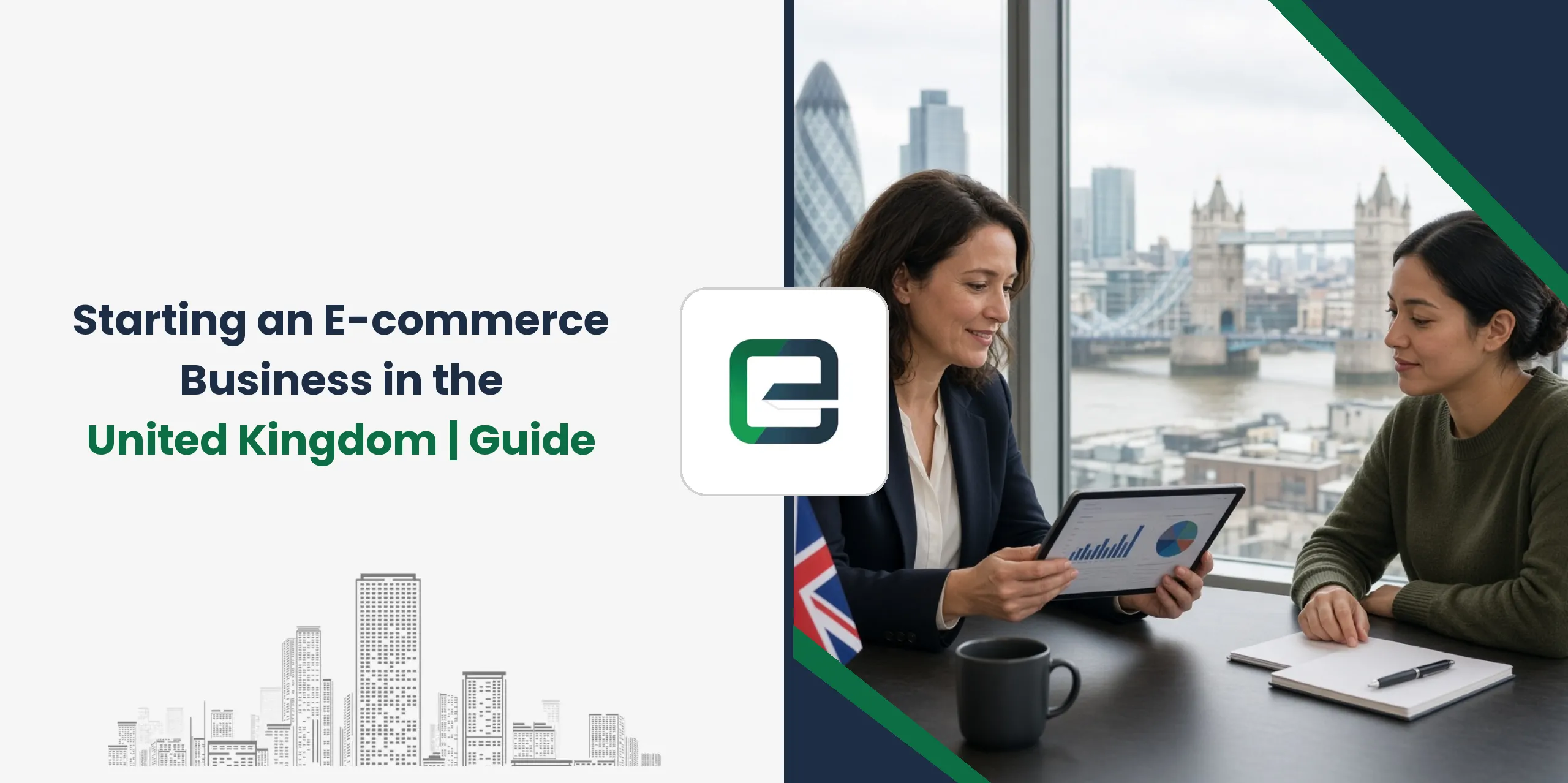
How Quickly Can You Start an E-commerce Business in the United Kingdom?
Starting an e-commerce business can take just weeks. With online shopping continuing to grow worldwide, low stock needs and nationwide delivery give UK sellers a substantial opportunity.
In this guide, we discuss business models, market research, registration, licensing, tax and ongoing compliance, so you can plan each step with confidence.
Table of Contents
hide
Which E-commerce Business Model Should You Choose?
The six most common models are dropshipping, affiliate marketing, white labelling, subscriptions, print on demand and software as a service.
The right model shapes your start-up costs, margins and day-to-day operations. It pays to choose one before you build the store, because each option suits a different level of investment and involvement.
1. Dropshipping and Affiliate Marketing
You list the products, but a supplier ships them directly to the customer. Stock risk stays close to zero. Affiliate marketing is similar: you earn commission by promoting other sellers' goods.
2. White Labelling and Subscription Services
White labelling means selling existing products under your own brand, which speeds up time-to-market. Subscription services bill customers on a recurring basis, creating predictable revenue.
3. Print on Demand
Designs are printed only after a customer places an order, so you never hold inventory. This pairs well with creative or niche audiences and keeps waste low.
4. Software as a Service (SaaS)
SaaS sells online access to software, usually monthly. It suits founders with a technical product rather than physical goods, and it scales without shipping logistics.
How Do You Study Competitors and Choose Products for Your Niche?
Start by studying competitor catalogues, spotting gaps and validating demand before you choose a niche.
Start by studying what competitors sell and, just as importantly, what they do not. Gaps in their catalogues often reveal your best entry point.
Understand your target audience before choosing products: their purchasing capacity, preferences and likely objections. Then select the specific items that audience is most likely to buy.
E-commerce lets you begin with a small catalogue and modest investment, then reinvest as sales grow. Scale gradually, testing demand one product line at a time rather than betting everything on launch day.
How Do You Register an E-commerce Business in the UK?
Online sellers can choose a limited company, sole trader or partnership, and the right structure depends on liability and funding needs.
Choosing a business structure establishes how your online shop will operate. A limited company gives limited liability protection and better access to funding. Sole trader and partnership structures, by contrast, offer more flexibility and control.
Registration requirements depend on your structure. Sole traders must register for Self Assessment if they earn more than £1,000 in a tax year; a nominated partner registers an ordinary partnership with HMRC, and the other partners register separately. Limited companies must incorporate with Companies House, and directors must verify their identity as part of the application — a requirement that became mandatory in November 2025. Companies are usually set up for corporation tax when they incorporate.
To compare structures, see our guide on Types of Business Entities to Set Up in the UK. Our Guide to Starting a Business in the United Kingdom and Guide to UK Company Registration cover the essentials, and the United Kingdom Company Registration Process page sets out each stage. Check availability with our Free United Kingdom Company Name Check and read the Guide to Select Your UK Company Name. For accounting planning, see Determining Financial Year End for UK Companies.
The typical launch sequence depends on your structure:
- Choose a business structure — sole trader, partnership or limited company.
- As a sole trader, register for Self Assessment when required.
- For an ordinary partnership, choose a nominated partner to register the partnership with HMRC; the other partners register separately.
- For a limited company, check your proposed company name, verify each director's identity, then file the incorporation application with Companies House and pay the fee. Check that the company is set up for corporation tax.
- For any structure, register for VAT when required, including when taxable turnover exceeds the statutory threshold.
Current Companies House fees, effective from 1 February 2026, are summarised in the fee table below. Full details, including the paper form IN01 and the online service, are on the official GOV.UK page used to register a private or public company.
Our Incorporation team — see United Kingdom Company Incorporation Services — prepares and files the whole application on your behalf.
Companies House Filing Fees for 2026
| Filing or service | Digital (online or software) | Paper |
|---|---|---|
| Incorporation | £100 | £124 |
| Same day incorporation | £156 | Not available |
| Change of name | £20 | £30 |
| Confirmation statement | £50 | £110 |
| Voluntary strike off | £13 | £18 |
Sole Trader vs Limited Company for UK Online Sellers
| Aspect | Sole trader or partnership | Limited company |
|---|---|---|
| Liability | Personal liability for business debts | Limited liability protection |
| Set-up | Register with HMRC | Incorporate with Companies House |
| Funding | Harder to raise investment | Better access to funding |
| Tax | Income tax and National Insurance | Corporation tax on profits |
What Licensing and Distance-Selling Rules Apply to Online Stores?
Licensing depends on what you sell: alcohol requires authorisation from the relevant licensing authority, which varies across the UK.
Selling online within the UK is broadly free of general licensing, but specific product categories carry their own rules. Alcohol requires authorisation from the relevant licensing authority, and sellers of age-restricted goods must follow the applicable age-verification rules.
Your store may also count as a distance-selling activity. Distance selling occurs where a sale is made via mobile or text message, digital television or the internet. A range of rules and exceptions applies: consumers generally have 14 days after delivery to cancel and another 14 days after notifying the seller to return the goods.
If your range includes drinks, our guide on starting a beverage business in the United Kingdom covers the licensing route in detail.
What Are Your Ongoing Tax and Compliance Obligations?
Once trading, a limited company files annual accounts and a confirmation statement; VAT returns are usually quarterly once taxable turnover exceeds the threshold.
Companies House requires limited companies to file annual accounts and a confirmation statement each year. The confirmation statement costs £50 when filed digitally and £110 on paper, as set out in the 2026 Companies House fee schedule above.
HMRC administers the VAT registration threshold. Registration is normally compulsory when taxable turnover exceeds £90,000 over the last 12 months or is expected to exceed £90,000 in the next 30 days; overseas sellers may need to register regardless of turnover, and returns are usually quarterly. Limited companies also pay corporation tax on profits, while sole traders report through Self Assessment.
Good digital record-keeping from day one keeps these filings routine. Our corporate secretarial support tracks every deadline so nothing slips while you focus on selling.
Can Overseas Sellers Set Up a UK E-commerce Business?
Yes — overseas sellers can either incorporate a UK limited company or register a UK establishment with Companies House.
Incorporating a UK company is often simpler for pure e-commerce. It gives you a domestic entity, a UK registered office and limited liability. Registration of a Foreign Company in the UK is the alternative for firms that keep their parent entity abroad; registering a UK establishment costs £124 on paper.
Since Brexit, the UK is no longer part of the EEA. Companies whose home country is inside the EEA must now report the same information as other overseas companies. GOV.UK publishes the full obligations for overseas companies in the UK.
Practical next steps include Bank Account Opening in the United Kingdom and registering for UK taxes. Founders comparing jurisdictions may also find our analysis of doing business in the United Kingdom vs Japan useful.
Conclusion
Starting an e-commerce business in the United Kingdom is a structured process rather than a leap: pick a model, register properly, secure the right licences and stay on top of filings. Get those four right, and the market is large, digital and receptive to new sellers.
3E Accounting UK is a Corporate Services Provider supporting startups, SMEs and multinational companies to launch and grow in the UK. We combine company incorporation, corporate secretarial, accounting, tax and business advisory with technology-enabled processes. Our work is backed by the 3E Accounting International Network.
You can learn more on our About Us page, read Why Us and meet Our Team. Our Awards and Milestones and Our International Network show the depth behind the service, and our Client Testimonial pages reflect real client outcomes. Clients of other providers can Switch to 3E Accounting UK at any time, and many manage filings on the go with Our 3E Accounting Mobile App. Our website Cookie Policy explains how we handle your data.
If you are weighing other ventures alongside your store, our industry guides cover starting a tutoring business in the United Kingdom, starting a car valeting business in the United Kingdom and starting a mobile beautician business in the United Kingdom. For sellers with global ambitions, our network also offers Uganda company formation among its international setup services.
Whatever you plan to sell, talk to us before you list your first product.
Launch Your UK Online Store with Confidence
3E Accounting UK handles incorporation, corporate secretarial and tax registration so you can focus on selling.
Frequently Asked Questions
Companies House charges £100 for online or software incorporation and £124 on paper, with a £156 same-day option via software. The annual confirmation statement costs £50 digitally or £110 on paper.
It depends on the product. Restricted goods such as alcohol require a licence from your local council, while most other categories can be sold online without a general licence, subject to distance-selling rules.
Yes. Sole trader and partnership structures offer flexibility and control. A limited company adds limited liability protection and better access to funding if you plan to grow.
Yes. Overseas companies can incorporate a UK limited company or register a UK establishment with Companies House for £124 on paper. UK bank account opening and tax registration follow.

Abigail Yu
Director
Abigail Yu oversees executive leadership at 3E Accounting Group, leading operations, IT solutions, public relations, and digital marketing to drive business success. She holds an honors degree in Communication and New Media from the National University of Singapore and is highly skilled in crisis management, financial communication, and corporate communications.